Matching is the whole project
The container cabinet becomes chaos because of orphans: lids with no base and bases with no lid. Start by dumping everything on the counter and pairing them. Anything unmatched goes to recycling where your local program accepts it.
Also remove anything cracked, stained, warped from the dishwasher or that holds onto odors. Takeout containers are fine for sending food home with guests, but keep only a handful.
Decide how many you need before keeping them
A quick way to set your number: count the leftovers you put away on a typical night, plus the lunches you pack per day, then add a small buffer. For many families that lands between 12 and 20 containers.
Choosing one system with a few sizes and the same lid shape is the best long-term fix. When three sizes share one lid footprint, matching stops being a daily chore.
- Small: dressings, dips, baby food, snacks
- Medium: single leftovers and lunches
- Large: soups, salads and batch cooking
- Glass for reheating; lighter plastic for school and work bags
Step by step
- Gather every container
Check the dishwasher, the lunch bags, the car and the office so your count is complete.
- Pair and purge
Match lids to bases and recycle or discard anything without a partner or in poor shape.
- Choose a target number
Keep roughly what you use in a week, favoring one shape family.
- Set up two bins
One for nested bases, one for lids standing upright by size.
- Hold a monthly check
When an orphan appears, deal with it right away rather than letting it migrate back.
Nest bases, file lids
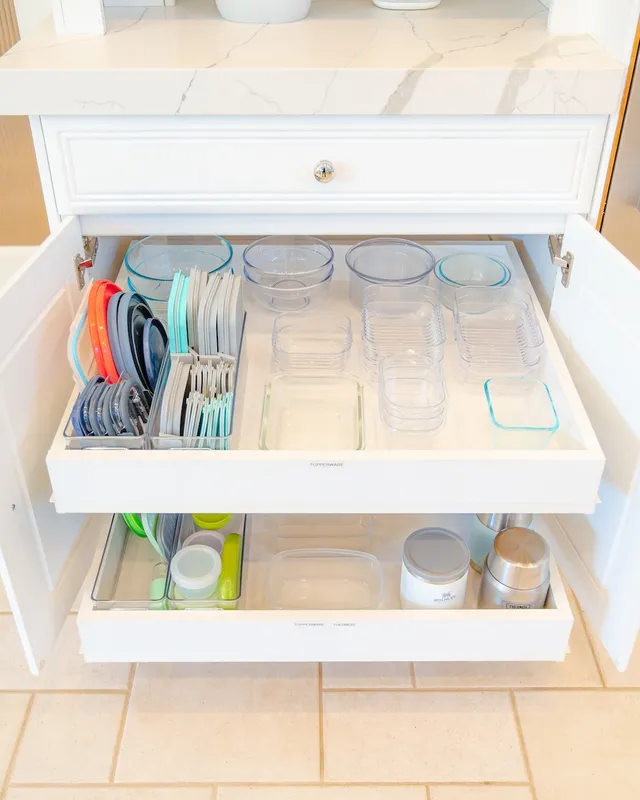
Bases nest largest to smallest in a single bin or one section of a drawer. Lids stand on edge in a separate bin or a divider, sorted by size, like files in a cabinet. You can see every lid at once and grab the right one without unstacking.
In a deep drawer, two bins side by side do the job. In a cabinet, use a pull-out bin for bases and a vertical lid organizer next to it. See our guide to deep kitchen drawers for divider options.
Place them in the food storage zone
Containers belong between the stove and the refrigerator, so you can pack leftovers and put them straight into the fridge. Keep foil, wraps, zip bags and labels for leftovers in the same zone.
If you meal prep on Sundays, a counter-height spot near the island also works. Our kitchen cabinet guide explains how to map zones.
Keep containers out of the garage in summer
Overflow plastics often get sent to the garage, but a Las Vegas garage in July can warp thin plastic and soften lids so they no longer seal. If you keep spare containers or a backup set, store them indoors, such as on a high pantry shelf.
Glass handles heat fine, but it is heavy and better kept low and indoors as well.